Clear Aligners for Teens: A Practical Guide for Parents
A parent's guide to clear aligners for teens: how they work, brand comparisons, what's normal at each age, real cost scenarios, a printable care checklist, and when to call the dentist.

Either your teen's dentist brought up aligners at a checkup, or your teen came home asking for them by name. Now you're the one deciding whether thin plastic trays are a sensible way to straighten a 14-year-old's teeth, and whether that 14-year-old will actually wear them. This guide walks through how teen aligner treatment works, what's typical at each age, how the major teen aligner systems differ, what a case costs in different scenarios, what makes treatment go smoothly, and when it's worth picking up the phone.
In this guide:
- What Clear Aligners Actually Are
- How Teen Aligner Brands Compare
- Why Straighter Teeth Matter Beyond the Photos
- What to Expect by Age
- Signs Your Teen May Need an Evaluation
- Is Your Teen a Good Candidate?
- Clear Aligners vs Braces for Teens: A Side by Side Look
- Tips That Make Treatment Go Smoothly
- Talking to Your Teen About Wear Time
- Common Mistakes to Avoid
- The Printable Aligner Care Checklist
- What It Costs and What Insurance Usually Covers
- When to Call the Dentist or Orthodontist
- Glossary: Aligner Terms Parents Should Know
- Frequently Asked Questions
What Clear Aligners Actually Are
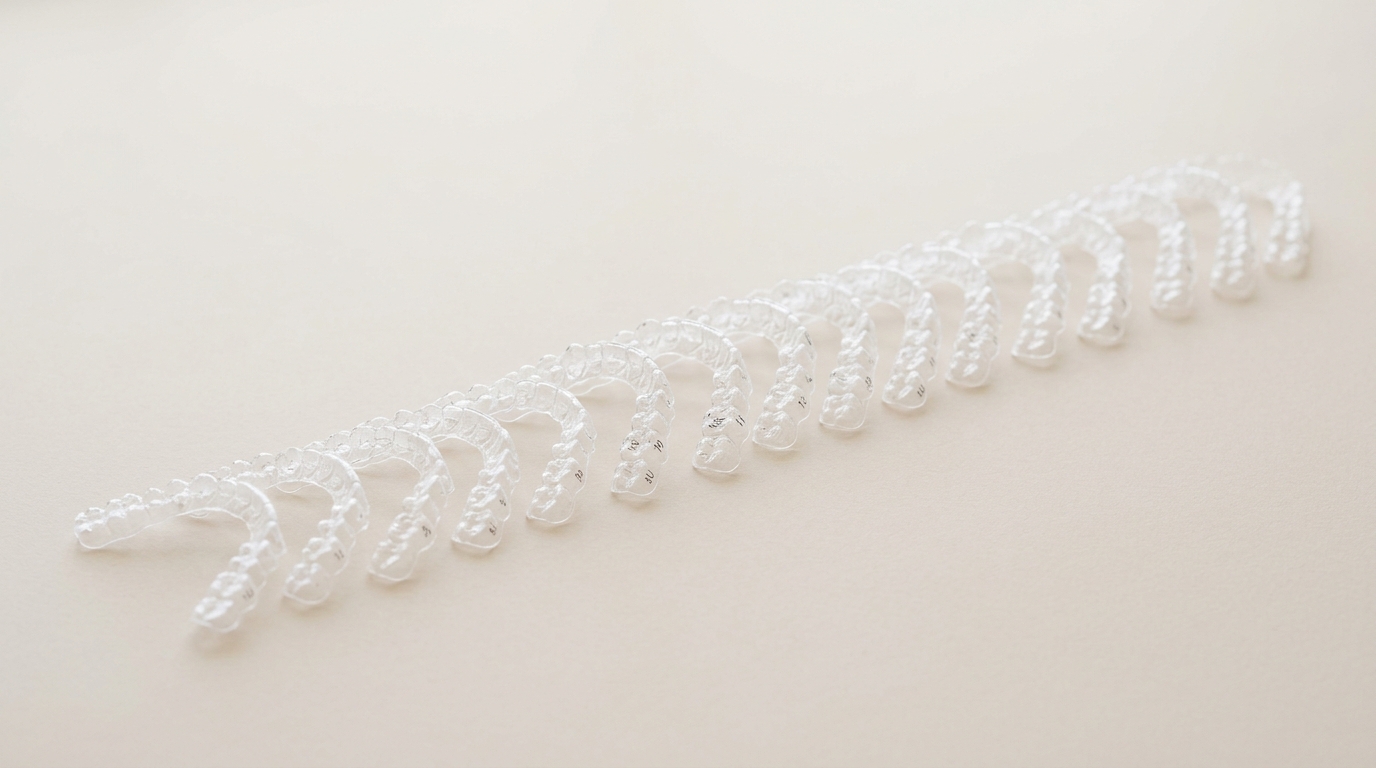
Clear aligners are custom-made plastic trays that slip over the teeth and move them a small amount at a time. Your teen wears one set for a week or two, then swaps it for the next tray in the series. Each tray is a little different from the one before it, and over months of tiny moves the teeth end up where the treatment plan says they should be. Invisalign is the name most people know, but several companies make aligners and most orthodontists work with more than one system.
A few things separate the teen versions from adult ones:
- Compliance indicators. Small blue dots on the tray fade with wear, so both you and the orthodontist can tell at a glance whether the trays are actually going in the mouth.
- Eruption tabs. Built-in empty pockets that leave room for adult teeth still coming in, so treatment doesn't have to wait for every last tooth.
- Replacement aligners. Teen plans usually include a few free replacements, because trays get lost. Everyone involved knows this.
Most cases also involve attachments, which are small tooth-colored bumps bonded onto certain teeth. They give the smooth plastic something to grip and push against. They don't hurt, they stay on for the whole treatment, and they're polished off at the end. They do make the aligners a bit more visible up close, which is worth mentioning to your teen before the first tray goes in rather than after.
How Teen Aligner Brands Compare
"Clear aligners" isn't one product. Several companies make teen-specific systems, and the differences matter more than the marketing suggests.
| System | How it's supervised | Typical fit for a teen |
|---|---|---|
| Invisalign Teen | In-person, by an orthodontist or dentist trained on the system | The most widely used teen system, and the one that popularized compliance indicators and eruption tabs |
| Spark Aligners | In-person, by a trained provider | A newer, clearer-material system some orthodontists offer teens who are self-conscious about visibility |
| ClearCorrect | In-person, by a trained dentist or orthodontist | A common alternative when a family's regular provider doesn't carry Invisalign |
| Direct-to-consumer mail-order kits | Remote, with limited or no in-person exam | Generally not recommended for a growing teenage mouth, since there's no one checking root position or bite changes along the way |
The system matters less than the provider running it. An experienced orthodontist gets good results with more than one brand. A newer provider on any single system is still learning its limits. Ask how many teen cases the practice has finished with the specific system they're recommending, not just how many they've started.
Why Straighter Teeth Matter Beyond the Photos
Crowded and overlapping teeth are harder to brush and floss well. Plaque tends to collect in the spots a toothbrush can't reach cleanly, and that's where gum inflammation and cavities usually start. Straightening the teeth doesn't clean them for your teen, but it removes some of the hiding places.
Bite problems can matter too. When upper and lower teeth don't meet evenly, some teeth take more force than they were built for, which can show up as uneven wear or chipping over the years. Front teeth that stick out noticeably are also a little more exposed during sports and falls.
And there's the part nobody clinical wants to write down: teenagers are aware of their teeth. If your teen is covering their mouth in photos, that's a real reason to look into treatment, not a vain one.
That said, mild crowding is not an emergency. Plenty of adults have slightly crooked teeth and perfectly healthy gums. Straightening is a reasonable choice, not a rescue mission, and there's no clock forcing you to decide this month.
What to Expect by Age
Ages here are a rough map, not a schedule. Kids run a year or two ahead or behind and that's normal.
| Age range | What's usually happening | What you can do |
|---|---|---|
| Around 6 to 7 | First adult molars and front teeth arrive | Book a first orthodontic check, even if teeth look fine |
| 8 to 10 | Mix of baby and adult teeth; crowding shows up | Keep cleanings regular; ask if early treatment has a specific purpose |
| 11 to 13 | Most adult teeth in except wisdom teeth | Common window to plan aligners; ask about timing |
| 14 to 16 | Jaw growth slowing; strong routine years | Typical treatment window; build the wear habit early |
| 17 to 19 | Growth mostly finished | Treatment still works; sort out retainers before college |
The general professional recommendation is a first orthodontic evaluation around age 7. That's early on purpose. It isn't about starting treatment at 7, it's about spotting the small number of issues that are easier to guide while the jaws are still growing. For most kids the answer at that visit is simply "check back in a couple of years."
What matters more than the birthday is how many adult teeth have arrived. Aligners can only move teeth that are actually in the mouth, so a teen with several baby teeth still hanging on may need to wait a bit.
Signs Your Teen May Need an Evaluation
You don't need to wait for a scheduled checkup if you notice any of the following. None of these mean something is seriously wrong, they just mean it's worth a professional look sooner rather than later:
- Teeth that clearly overlap or crowd as the adult teeth come in
- A visible gap between the front teeth that isn't closing on its own
- An upper jaw that noticeably overlaps the lower one, or the reverse
- Teeth on one side that don't line up the same way as the other side
- Your teen breathing through their mouth most of the time, awake or asleep
- Clicking, popping, or discomfort in the jaw joint when chewing or opening wide
- Baby teeth that fall out much earlier or later than a sibling's did at the same age
- A thumb-sucking or pacifier habit that continued past about age 5
Any one of these is a reasonable reason to book an evaluation. It's a look-and-advise visit, not a commitment to treatment.
Is Your Teen a Good Candidate?
Aligners tend to work well for crowding and spacing that's mild to moderate, for teeth that need tipping and gentle rotation, and for bites that are close to correct already. They also suit a teen who genuinely doesn't want metal on their teeth and is organized enough to keep track of a small plastic object.
They're a harder fit when the case involves a significant jaw size difference, teeth that need to be moved a long way up or down in the bone, or teeth that need large rotations. Round teeth like canines and premolars are especially tricky for a smooth tray to grip and turn.
The other honest factor is wear time. Aligners only work while they're in the mouth, and the standard instruction is 20 to 22 hours a day. Braces are glued on and keep working whether or not anyone remembers them. That isn't a knock on either option, it's just a real difference. If you already know your teen loses their phone charger weekly, say that out loud at the consultation. A good orthodontist will factor it into the recommendation instead of talking you out of it.
Clear Aligners vs Braces for Teens: A Side by Side Look
Both move teeth well. The right choice usually comes down to the specific case and your teen's habits, not a general winner.
| Clear aligners | Traditional braces | |
|---|---|---|
| Visibility | Hard to notice at conversation distance | Visible at all times |
| Removable for eating | Yes, so no food restrictions | No, so sticky and hard foods are off-limits |
| Brushing and flossing | Normal routine, trays come out first | Requires extra tools around the brackets and wires |
| Depends on teen compliance | Heavily, 20 to 22 hours a day required | Not at all, it works regardless |
| Best suited for | Mild to moderate crowding, spacing, minor bite issues | Complex bite corrections, large jaw discrepancies, big tooth movements |
| Office visits | Typically every 6 to 10 weeks | Typically every 4 to 8 weeks |
| Sports and instruments | Comes out for both | A mouthguard is worn over the brackets; instruments need an adjustment period |
| Losable | Yes, and lost trays cost time and sometimes money | No, it's bonded on |
| Typical cost range | $3,000 to $8,000 | $3,000 to $7,500 |
Neither figure is a quote. Both depend on how complex the case is and where you live.
Tips That Make Treatment Go Smoothly
- Anchor the trays to existing habits. Out before eating, back in right after brushing. A habit attached to another habit sticks better than a reminder.
- Keep a case in the backpack and a second one in the sports bag. Most lost aligners were set down somewhere without a case.
- Set a recurring phone alarm for tray-change night so nobody has to remember the date.
- Water only while the trays are in. Soda, juice, sports drinks, and sweet coffee get trapped against the enamel by the plastic, which is exactly the wrong place for sugar to sit.
- Brush before reinserting when possible. A rinse is the fallback, not the plan.
- Hold on to the previous set of aligners until the next one is well underway. If a tray is lost, the old one can hold the position until the office says otherwise.
- Take a photo of the smile every few weeks. Progress that's invisible day to day is obvious across two months, and seeing it keeps a teenager motivated.
- Let your teen own the tracking as much as they can handle. Compliance goes up when it's their project instead of your reminder.
Talking to Your Teen About Wear Time
Nagging about aligners tends to backfire the same way nagging about homework does. A few approaches work better:
- Connect it to something your teen already cares about, a school photo, a specific event, a sport season, rather than an abstract "your teeth."
- Give them the tracking tools instead of being the tracker. A phone alarm they set themselves is followed more often than a reminder from a parent.
- Praise the streak, not the perfect record. "You've kept up with it all month" lands better than pointing out the one missed evening.
- Ask, don't inspect. "How's it going with the trays?" opens a conversation. Checking their mouth at dinner does not.
- Explain the actual consequence in plain terms. Under-wearing doesn't ruin anything permanently, it just means more trays and more months. Teens respond better to a real, specific outcome than a vague warning.
- Loop your teen into the cost conversation if it's appropriate for your family. Teens who understand what a lost tray costs to replace often become more careful with the case.
Common Mistakes to Avoid
- Wrapping a tray in a napkin at lunch. This is the single most common way aligners end up in a cafeteria trash can.
- Waiting to report a lost tray. Call the office that week. Teeth start drifting back within days, and a small course correction beats a big one.
- Cleaning trays with hot water. Hot water, boiling, and dishwashers all warp the plastic. Cool water and a soft brush are the whole routine.
- Skipping regular dental cleanings. Orthodontic visits are not the same as a checkup and cleaning. Keep both on the calendar.
- Treating retainers as optional at the end. Retention is part of the treatment, not a bonus round.
- Comparing timelines with a friend. Two teens with similar-looking teeth can have very different plans, because what's happening below the gumline isn't visible in a photo.
- Forcing a tray that won't seat. If it doesn't go all the way down, stop and call. Something in the plan needs adjusting.
The Printable Aligner Care Checklist
Save this section or screenshot it. It covers the routine at three timescales so nothing gets missed.
Every day
- Trays in for 20 to 22 hours
- Out only for eating, drinking anything but water, and brushing
- Brush and floss before putting trays back in
- Case goes wherever the trays go, never a napkin
Every week (tray change)
- Old tray stored, not thrown out, until the next one is settled in
- New tray checked for a full, even seat on every tooth
- Any sore spot noted; call the office if it hasn't eased in two weeks
- Progress photo taken
Every appointment cycle
- Attachments checked, none missing or lifted
- Compliance indicator dots checked for fading on schedule
- Questions written down beforehand so nothing gets forgotten in the room
- Next appointment booked before leaving
What It Costs and What Insurance Usually Covers
Clear aligner treatment for a teen in the US commonly falls somewhere in the range of $3,000 to $8,000. Short, simple cases can come in below that. Long or complex ones can go above it. Nobody can quote you a real number without an exam and x-rays, so treat any figure you see online, including this one, as a planning range rather than a price.
What pushes a case toward the higher end:
- More complex bite correction and a longer treatment time
- A big-city practice with higher overhead
- An experienced orthodontist with a long track record in aligners
- Extra refinement stages, which are additional trays made partway through to fine-tune the result
A few realistic scenarios, to make the range concrete:
| Scenario | Where it tends to land |
|---|---|
| Mild crowding, short treatment, no refinements needed | Lower end of the range |
| Moderate crowding or spacing, average length treatment | Middle of the range |
| Bite correction involved, or one or two refinement rounds | Upper end of the range |
| Complex case, multiple refinement rounds, longer treatment | Can exceed the typical range |
When you compare quotes, ask what's actually bundled in: refinements, replacement trays, the retainers at the end, and follow-up visits after treatment finishes. A lower headline number that excludes retainers isn't really lower.
On insurance, many dental plans include a separate orthodontic benefit with a lifetime maximum, often applying to dependents under 19. It's a one-time pot of money, not an annual one, and it usually covers a portion rather than the whole bill. FSA and HSA funds can typically be used for orthodontic care. Most practices also offer in-house monthly payment plans, frequently without interest, so ask what the monthly figure looks like before you rule anything out.
When to Call the Dentist or Orthodontist
Routine questions can wait for the next visit. These are worth a call:
- A tray cracks, splits, or no longer seats fully on the teeth
- A tray is lost, or your teen has been out of aligners for more than a day or two
- An attachment pops off a tooth
- A sore spot on the cheek, gum, or tongue that isn't healing after about two weeks
- Gums that are red, puffy, or bleed when brushed
- Sharp pain, or a tooth that feels genuinely loose rather than just tender
- Your teen simply isn't wearing them
That last one deserves saying plainly. Under-wearing aligners is common and it isn't a moral failure. What causes real problems is hiding it, because the plan quietly falls behind and nobody adjusts. Orthodontists deal with this constantly and have options, including switching to braces partway through. Tell them early.
Keep the regular six-month dental checkups going through treatment as well. The orthodontist is watching tooth position, and your general dentist is watching for cavities and gum health.
Glossary: Aligner Terms Parents Should Know
Attachments: Small tooth-colored bumps bonded to certain teeth so the aligner has something to grip and push against.
Chewies: Small foam cylinders a teen bites down on for a few minutes after inserting a new tray, to help it seat fully.
Compliance indicators: The fading blue dots on teen aligners that show the orthodontist how many hours the trays are actually being worn.
Eruption tabs: Built-in gaps in the tray that leave room for an adult tooth still coming in, so treatment doesn't have to wait for every tooth to arrive.
IPR (interproximal reduction): A small, painless amount of enamel removed from between two teeth to create space, used in some cases instead of pulling a tooth.
Malocclusion: The clinical term for teeth or jaws that don't line up correctly, covering everything from mild crowding to a significant overbite.
Refinements: A second set of trays made partway through treatment to fine-tune movements the first set didn't fully achieve.
Retainer: The appliance worn after active treatment ends to keep teeth from drifting back. Comes as a clear tray similar to an aligner, or a wire-and-acrylic Hawley retainer.
Frequently Asked Questions
How many hours a day does my teen really have to wear them?
Aim for 20 to 22 hours, with the trays out only for eating, drinking anything other than water, and brushing. Missing an hour here and there won't undo anything. A pattern of short days stretches the treatment out and can mean redoing a stage.
Can my teen still play sports and a wind instrument?
Yes. For contact sports the aligners come out and a mouthguard goes in, so pack both in the same bag. Wind instrument players usually need a few days to adjust their embouchure, and some prefer to take the trays out to play and put them straight back in.
Do aligners work as well as braces?
For many common cases, yes, the results are comparable. For complex bite corrections, big jaw discrepancies, or teeth needing large movements, braces are often more predictable. Ask the orthodontist to explain specifically why they're recommending one over the other for your teen's mouth.
What if my teen just refuses to wear them?
It happens, and it's fixable if you catch it early. The compliance indicators on teen aligners mean the orthodontist will see it anyway, so there's no advantage to waiting. Many practices can switch a patient to braces mid-treatment without starting the whole plan over.
Will my teen need a retainer afterwards?
Yes, and this part isn't optional. Teeth keep drifting slowly throughout life, whether or not someone had braces. The usual pattern is full-time retainer wear for a few months, then nights only, continuing long term.
Do aligners hurt?
Each new tray usually brings a couple of days of pressure or mild soreness as it moves teeth into their next position, not sharp pain. Over-the-counter pain relief and sticking to softer foods for a day or two usually covers it. Pain that's sharp, doesn't ease, or centers on one tooth is worth a call.
How much does replacing a lost aligner actually cost?
It varies by practice and by how many free replacements the plan includes, since most teen plans build a few in. Past that allowance, a replacement tray is typically a modest fee rather than a major expense, but ask the office up front what their policy is so it isn't a surprise later.
What actually happens at a typical aligner checkup?
The provider checks tray fit and tracking, looks at how each tooth is moving against the plan, checks attachments for wear or lifting, and hands over the next batch of trays. Most visits run 15 to 20 minutes, shorter than a typical braces adjustment.
Should we see an orthodontist or a general dentist for aligners?
Both can be trained and certified on aligner systems. Orthodontists specialize exclusively in tooth movement and typically handle more complex cases; some general dentists offer aligners for straightforward crowding and spacing. Ask directly how many teen aligner cases the provider has completed, regardless of which type of practice you're in.
Can my teen wear a sibling's old retainer or leftover aligners?
No. Aligners and retainers are custom-molded to one specific set of teeth at one specific point in treatment. Wearing another person's, even a sibling's, won't fit properly and can push teeth in the wrong direction rather than holding them in place.
This article is for general information only and is not a substitute for professional dental advice. Always consult your dentist about your individual needs.